Showing posts with label The Hunchback of Notre Dame (1977). Show all posts

Thursday, June 4, 2015

Conclusion: The Hunchback of Notre Dame (1977):

The 1977 version is an excellent dress rehearsal.

I think that sums it up pretty well. It is cheap. Really cheap. Even for a TV movie...even for a TV movie from the 70s. The production ultimately suffers because of it. The low production values, the basic camera work, the minimal sets, end up breaking any sense of immersion. It takes the audience out of the story when they are reminded that what they are watching is people in costumes talking in front of Styrofoam buildings.
Kenneth Haigh as Claude Frollo

The actors are mostly B-listers, but that's not necessarily a bad thing. The 1970s was a time for unconventional actors. The ones here are fine. Barring a few exceptions, the performances are often well done. There's nothing Oscar (Or should I say Emmy) worthy in this movie, but nothing outright terrible either

Yet these actors aren't nobodies, like you would typically see in TV productions. Kenneth Haigh and Warren Clarke were recognized actors at the time. Clarke was even in a Stanley Kubrick film.

Warren Clarke as Dim, A Clockwork Orange (1971).

The script by Robert Muller is not half bad. While the frequent shift of focus to Jehan Frollo is a bizarre one to say the least, the dialogue and general plotting is fairly well done. It touches, though perhaps a bit too bluntly, on a lot of Victor Hugo's themes. It's not Shakespeare or anything, but it at least shows signs of effort.
Jehan and Quasimodo

I dare to say that, with this script and these actors, you could have made a good film. I'm not going to go as far to say that you would have had another Citizen Kane, but at the very least it could have been an enjoyable historical melodrama.

That doesn't prevent this version from being a bad movie.

The acting is alright, but it feels like it isn't at its full possibility. Like stated earlier, it feels unfinished, like a dress rehearsal. Kenneth Haigh in particular can get a bit over the top.

The lousy production values ultimately undermine the potential of an entertaining film.

Wednesday, June 3, 2015

The Costumes and Makeup of The Hunchback of Notre Dame (1977)

Despite the cheapness of the sets and cinematography, the costumes are really well done.

Quasimodo's facial deformity shares very little in common with Victor Hugo's descriptions. Like many other adaptations, the design is in the tradition of Charles Laughton in the 1939 version. Clarke's makeup features short messy hair and a single working eye.

Unlike Laughton, this eye is merely dead and facing upwards instead of being lowered.

At times it works.

Other times it doesn't.


This is probably the only Quasimodo to wear a half red and half purple outfit. They even included the silver bells. It's a nice touch.

Frollo wears black, as is to be expected. He wears a cross around his neck, almost shouting out his priesthood. His hair is brown and kept fairly short. As I've explained earlier, this addition is out of place and out of character.
Frollo also occasionally wears a black cap.


Esmeralda wears two costumes in this version. The first is a red dress.


The second is her execution gown.


The extras are typical period fare. Rags for the beggars, dresses for the nobles, nothing that's really out of the ordinary. The costumes seem period appropriate, even if the style of some of the hair is a clear product of the '70s.


Compared to the other production values, the costumes are really good, almost like they were from a real movie...


Next: Conclusion 

Tuesday, June 2, 2015

The Sets and Cinematography of The Hunchback of Notre Dame (1977)

It is clear that the production values of the 1977 version of are the biggest problem. The whole production looks like a stage play, and at times that claim seems generous.

The interior of Notre Dame looks like a High School gym.
Interior of Notre Dame de Paris

Or a broom closet...

Interior Set, inside of Notre Dame

The Lively City Streets
The Paris streets are fairly empty most of the time. The town square is just a few unfinished buildings. You would hope that the filmmakers would try their best not to break the suspension of disbelief, but nope. They didn't even bother to finish half of the sets before shooting. This version isn't so much a cast of thousands so much as it is a cast of, perhaps, a dozen or so.

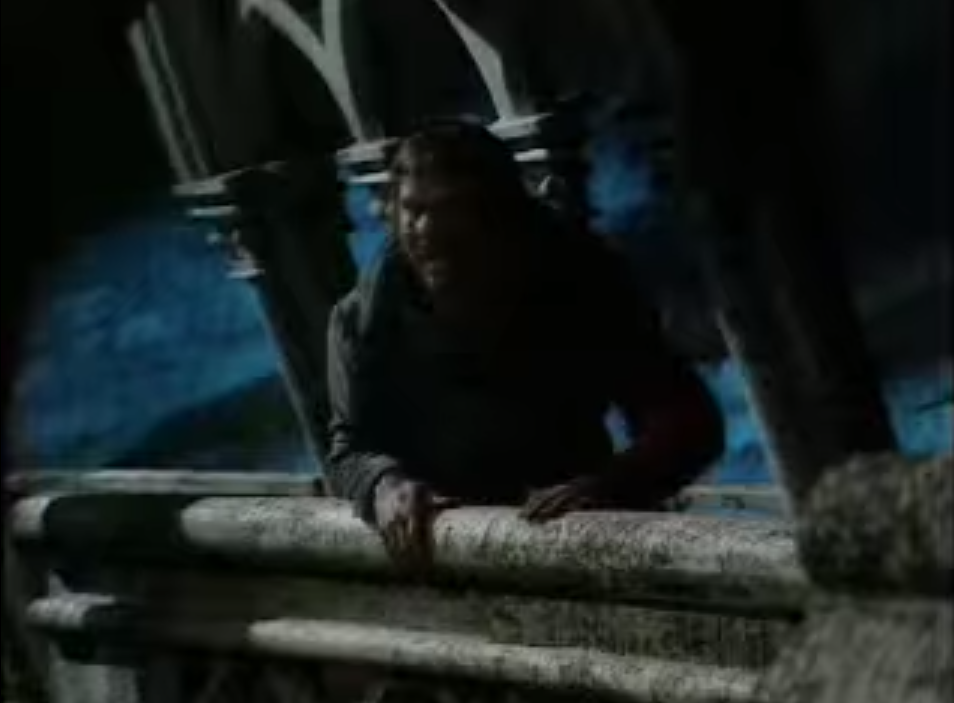
The balcony of Notre Dame
Notre Dame itself looks like it's made out of Styrofoam. (Who knows, it could be?)

Besides the cathedral doors, mostly what we see of the architecture of Notre Dame is a single balcony.

The few other parts of the church that are shown are usually nothing more glorious than random columns and arches.


Whenever an exterior shot is needed, the filmmakers choose simply to cut to a drawing of the church.

Exterior of Notre Dame de Paris
No, not a matte painting.

No, not a photograph.

A drawing, a sketch.

The effect is laughable, to say the least.


The camera work is very stale, but that's to be expected for television, especially in the 1970s. To give credit where credit is due, there are a few inventive moments that I really like, there are some great Psycho-esque shots of Frollo peering through a crack in the wall, but creative stuff like that is few and far between.
Frollo  peers through a crack


The majority of the shots are like this:
Quasimodo confronts Frollo


Flat and lifeless. Standard television blocking and staging. Efficient yes, but inspiring? I don't think so.


Next: The Costumes and Makeup


Monday, June 1, 2015

Review of the Characters of The Hunchback of Notre Dame (1977)

Quasimodo is portrayed here by Warren Clarke. He does an adequate job. Clarke doesn't do much to elevate his performance, but it's not bad. His Quasimodo is mostly on point to his literary counterpart, but the filmmakers, or at least the screenwriter, do not make Quasimodo very impactful. His scenes are often overshadowed by other characters when the focus should be on him.

Warren Clarke
The best example of this is during his trial. A scene which, in the book, is meant to show the problems with the justice system. A justice system which allows an auditor, a person whose sole job is to listen, to be a deaf man. Quasimodo, also deaf, is subjected to this Justice.

Here, the focus is moved to, of all people, Jehan Frollo. He uses Quasimodo as an example for how he and his fellow students should be let off the hook for their rambunctiousness. He then goes and pretends to be Quasimodo's lawyer. Then, Claude Frollo enters, greeting Gringoire, but not his brother or adopted son. 

Quasimodo, whose on trial, just blows a raspberry.

His costume is very close to Hugo's description. "Half red, half violet, sewn with silver bells."

Kenneth Haigh
Claude Frollo is probably the most interesting depiction in this version.  

Kenneth Haigh, a man in his forties, looks youthful. He has a full head of  brown hair, sweet sparking eyes, and a brow hardly touched by the horrors of age. 

That is not Frollo.

Frollo is bald, austere, with wrinkles and deep expressive eyes. His aged appearance is the physical manifestation of his internal self. Comptemptous to his fellow man and irrationally fearful of women. A bitter old man. Haigh is none of these things. His appearance is inviting, not threatening. 

Perhaps this was the filmmakers intention, playing with the theme of the deception of looks, but I'm not one to say for certain. Haigh's performance is actually quite good. He's not very menacing, (Though his voice certainly can be) but he doesn't completely fumble with the material. He's quite proficient in getting across Frollo's pathos. 

It's not perfect however. At times, the way he inflicts his voice becomes over the top. Some of his dialogue is very overwritten and his delivery only adds to it. 

"Oh my Lord, is it the world that has gone mad...or is it I?"

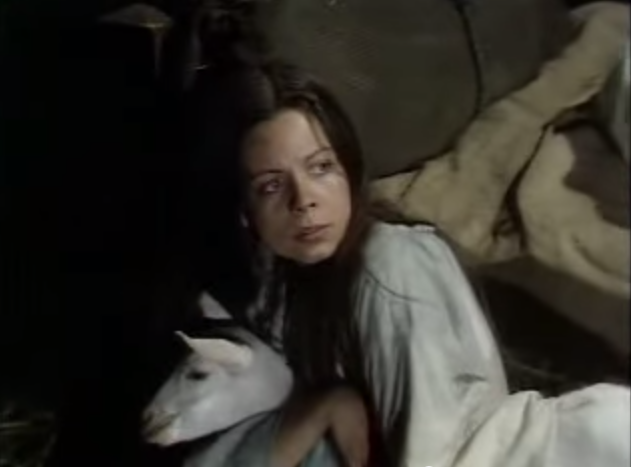
Michelle Newell
Good, not great.

Esmeralda, likewise, is also very faithful to the source material.

I don't want to sound mean, but, the actress who plays Esmeralda is a bit homely. Within the logic of the story, a young girl who lives on the street, it makes sense, but I don't know.

I like how she makes a comparison between herself and Quasimodo. It brings to mind this quote from the novel:

"They were two extremes of social and natural wretchedness coming into contact and aiding one another."

Richard Morant
Phoebus is truly a secondary villain here. There's not a hint of ambiguity. From his introduction, where he taunts Quasimodo and hits on Esmeralda, to his marriage celebration which takes place as all around him die, he's ruthless. For what the filmmaker's intentions were, the portrayal is really effective.


Christopher Gable
Physically, this is the most accurate interpretation of Pierre Gringoire. His personality is also mostly on point, tough his dialogue can drag a bit, he's quite funny, and is used to spell out some of the themes. He is given a more fleshed out character arch, and has the last line.
"Yet only I am spared to tell the tell...there is a God in heaven!"


David Rintoul

The real star of this version is David Rintoul  as Jehan Frollo. Almost all of the action is witnessed through his eyes. Quasimodo's trial and flogging, Gringoire's mystery play, as well as almost all of Frollo's personal scenes. He is the mouth piece for a lot of Hugo's ideas. He talks about the fickle nature of "the people" during Quasimodo's torture and the siege of the cathedral. Jehan is no longer just a comic relief, but a major focus character. He is jealous of Quasimodo as he receives more attention than himself by Frollo. He pops in often to acknowledge Frollo's poor parenting and psychological decline.

Jehan seems like a strange character to turn into a focus, but it's a very interesting way to view the story.

The other characters are mostly adequate. Fleur de Lys and Clopin are well done, for all that's worth.

Next: The Sets and Cinematography The Hunchback of Notre Dame (1977)

Sunday, May 31, 2015

Review of the Plot of The Hunchback of Notre Dame (1977)

The plot is fairly straightforward from the book.

A play written by Pierre Gringoire is being preformed at the Palace of Justice. The audience however, is not very receptive, particularly Jehan Frollo, the brother of the archdeacon. 

As a diversion, the people decide to elect a pope of fools. Quasimodo, the bell ringer is chosen, despite the objections of Claude Frollo, the archdeacon who insists that Quasimodo is "Deaf and good" while the public are "all swine." 

Nevertheless, Quasimodo is carried off.

Robin Pousspain calls the remaining attention to La Esmeralda, who is dancing in the square.

Among the people watching the gypsy is Frollo.

Quasimodo returns and is dethroned by Frollo. Quasimodo pleads that his his jeerers have "Made me their pope, monsenior" but Frollo warmly encourages him to "come home."

As Gringoire follows Esmeralda, Quasimodo and Frollo attempt to kidnap the gypsy. They are stopped by Phoebus, who arrests Quasimodo and enchants Esmeralda. Seeing her leave, Phoebus remarks that he'll "Have her front back and sideways."

Gringoire is captured by beggars and put on trial their king, Clopin. His life is offered to be spared if someone will marry him, and Esmeralda ends up doing so, though only out of pity.

The next day, Quasimodo is on trial for his crime of kidnapping. Jehan and Robin discuss the deaf auditor, Master Florain, and mock him. They are also on trial for causing a riot with their fellow students. Quasimodo, fearful of his master's presence, says random answers, causing the students to laugh. Jehan calls Florain an "old goat." Florian believes it is Quasimodo who said this insult, and worsens his punishment accordingly.

Jehan Frollo, encouraged by Robin Pousspain, takes the opportunity to be Quasimodo's lawyer, explaining how he, as the brother of the archdeacon, is given the benefit of the doubt. Jehan gives some background on Quasimodo and his upbringing. "This malformed monster who, though often incoherent, is not dumb, but almost as deaf as your worthy auditor!" he proclaims. He is shot down, and Quasimodo is sentenced to a flogging. Gringoire attempts to appeal to Floarian, saying that Quasimodo's deafness renders the case unproven. He is instead sentenced to two hours in the pillory.

While Quasimodo is being flogged, Jehan provides commentary on the fickle nature of human beings. Frollo approaches the pillory, but leaves Quasimodo to suffer. Quasimodo begs for water, but is mocked by the people. Esmeralda renders him succor from her canteen. When Quasimodo is freed, and returns to his tower, he rings the bells, but is distracted by Esmeralda. He gazes at her from afar. He has fallen in love with the gypsy.

Gringoire is scolded by Frollo for being married to Esmeralda. Gringoire wonders if Frollo is unwell.

Esmeralda is invited to dance for Phoebus and Fleur de Lys. The noblewomen mock Esmeralda, saying that "She hardly smells at all." Phoebus arranges a date with Esmeralda.

In his cell, Frollo is practicing alchemy. Jehan enters, begging for money. Jehan taunts Frollo about how he is a "profligate younger brother," Quasimodo is the "Ibecile foundling subjected to the indignities of the pillory" and that Gringoire has become a "Gypsy's pimp." Jehan explains to his brother all about the "Squalid melodrama" revolving around Esmeralda. He reveals how Phoeubs and Esmeralda will be together that night.

Frollo confronts captain Phoebus, who allows the mad priest to watch him and Esmeralda have their way with one another. Esmeralda attempts to convince Phoebus that she must remain chaste. While Phoebus is making his move, Frollo bursts out from his hiding place and stabs Phoebus. Esmeralda is convicted of the crime.

Quasimodo has a nightmare of the previous kidnapping, how he was forced into it by Frollo.

Esmeralda is on trial for the murder of Phoebus. She denies all of the accusations brought forth by the witnesses and by Charmalou the prosecutor. Under torture, she confesses and is sentenced to die. Frollo visits her while she is imprisoned. He offers her safety in exchange for her becoming submissive to him. She rejects him.

Esmeralda is being prepared for execution. Gringoire appeals to Frollo, begging that that "She is innocent," but Frollo ignores these claims. While preforming Esmeralda's last rites, Frollo once more offers himself to her. Esmeralda sees Phoebus with Fleur de Lys and rejoices. Esmeralda tells Frollo that she should be free, seeing as how she is condemned for a crime never committed. Charmalou callously says that "People have come to see a hanging, not to debate the ethics of our judicial system." and brings Esmeralda to the scaffold.

Quasimodo rushes from the cathedral doors. He accends the scafold and throws the executioner into the crowd. He carries Esmeralda into the safety of the cathedral, shouting "Sanctuary," in the process.

Jehan proclaims Quasimodo to be "The best lawyer (he) ever saw."

In the cathedral, Quasimodo brings food and drink for Esmeralda. She tries to communicate her gratitude, but he tells her bluntly that "Quasimodo does not look upon Esmeralda."

Frollo, interrupted during his contemplation, tells Jehan to be "Damned", to "Roast in hell," and to "burn forever."

From the towers, Esmeralda spots Phoebus. She shows Quasimodo, who realizes that Phoebus is how a man is supposed to be: handsome.

Quasimodo, on Esmeralda orders, approaches Phoebus. Phoebus kicks Quasimodo to the ground. When he returns to Esmeralda, she is enraged, continuously striking the hunchback, crying "I hate
you!". Quasimodo merely thanks her and leaves.

Quasimodo, sobbing, rings the bells of Notre Dame. Frollo acends to the tower and attempts to rape Esmeralda. Quasimodo stops him, but upon recognizing Frollo, he begs to be killed. Frollo promises that "No one shall have her!"

Frollo tells Gringoire that the King has called for Esmeralda's death. Frollo tells Gringoire to exchange himself with Esmeralda in order to save her. Gringoire counters this, saying that he could convince Clopin to start a riot.  Gringoire is reluctant to do so, fearing bloodshed, but agrees when guilted by Frollo.

That night, Clopin leads the beggars from the court of miracles to Notre Dame

Quasimodo throws timbers and stones, killing many vagabonds. He wants to protect Esmeralda. He feels that he'll "Damn (him)self, but it's for her."

Jehan and Robin cheer, commenting on how others are willing to kill for the vague notion of "the people."

Gringoire and Frollo bring Esmeralda out of Notre Dame. When the three of them reach the end of their destination. Gringoire leaves, pathetically apologizing for saving himself. Alone with Frollo, Esmeralda begs for someone to "fetch the bellringer" to save her.

Frollo gives Esmeralda to the hangman after being rejected for the final time.

The cavaliers arrive at Notre Dame, killing many vagabonds, including Jehan.

Frollo laments to Charmalou about the death of Jehan and how Quasimodo must be put to death.
Frollo walks up to the cathedral balcony. Quasimodo begs his master to save Esmeralda from execution. Frollo proclaims that Quasimodo is "Beyond salvation". The hunchback is struck down by his master. Tearing up, he moans that he "Loved (Frollo). My master...my idol...my father..."

The executioner kicks away the ladder, and then jumps and swings on Esmeralda's broken neck. Frollo smiles at this, resulting in Quasimodo tossing him off of the cathedral. Quasimodo is in despair. All that he loved is dead.

While the bodies of the recent dead are removed, Phoebus, Fleur de Lys and the entire nobility dance, in honor of their recent marriage.

The plot is probably the closest an adaption has come to the original novel. This is especially true in the film world. I don't think other faithful adaptations like Notre Dame de Paris (1956) and Parizes Dievmates Katedrale (1997) have a lot of the elements that this version has. For good or for ill, this version deserves credit for that.

Next: The Characters of The Hunchback of Notre Dame (1977)

Friday, May 15, 2015

The Hunchback of Notre Dame (1977)

This version is regarded as one of the most faithful adaptations ever made.

Released strictly to British television in 1977, the movie had decent ratings and was rerun for a few years.

Like many obscure made for television films, Hunchback has yet to be released on home video. Neither dvd or bluray. To my knowledge, it's not even on VHS (Excluding bootlegs of coarse).


That's how I'll be watching this one. A bootleg that was uploaded to YouTube during the winter of 2008 by Hugosnotredame.

Because of its obscurity, information regarding this adaptation is fairly scarce, and I apologize for that. That's just how things turned out.