Sunday, September 13, 2015

Characters: The Hunchback of Notre Dame (1923)

Lon Chaney as Quasimodo
Lon Chaney plays Quasimodo as very bestial and grotesque, and it is likely that this is the element of the character that appealed to him. Chaney was an actor who excelled with bizarre and demanding roles. His talents earned him the nickname of "the man of a thousand faces."

He went through a lengthy and painful makeup process for the role. Chaney's Quasimodo looks as if he stepped right out of the Victor Hugo novel.

The more emotional elements of Quasimodo are not as explored here as in the novel. The filmmakers seem more interested in showing Chaney flick his tongue and climb about Notre Dame than they are in showing his pathos. When those parts do show up, Chaney plays them beautifully. Like his tongue flicking and limp, Chaney plays the role as an animal. He allows Esmeralda to pet his head like a loyal dog. Chaney's efforts paid off in spades. He's the most memorable thing about this movie.

Patsy Ruth Miller as Esmeralda
Patsy Ruth Miller's depiction of Esmeralda is seen as the most accurate depiction of the character on film according to Victor Hugo's decedents.The actress herself was irritated by the fact that people only recognized her "for being in The Hunchback," and not her other movie and radio roles.

 The role isn't very different than many previous dramatic adaptations. She's not to far off from the way the character was shown in Louise Bertin's La Esmeralda or in Edward Fitzball's The Deformed of Notre Dame. Very innocent, a "child of mystery," as a title card describes her.

Brandon Hurst as Jehan
Brandon Hurst plays Jehan, who is essentially this adaptation's substitute for Claude Frollo. The reason the change of character was made is fairly simple. Negative portrayals of clergymen were taboo, even in edgier pre-code silent films. Thus Jehan, Frollo's profligate brother, a very minor character in the book, is made into the villain, and a decidedly more secular one.

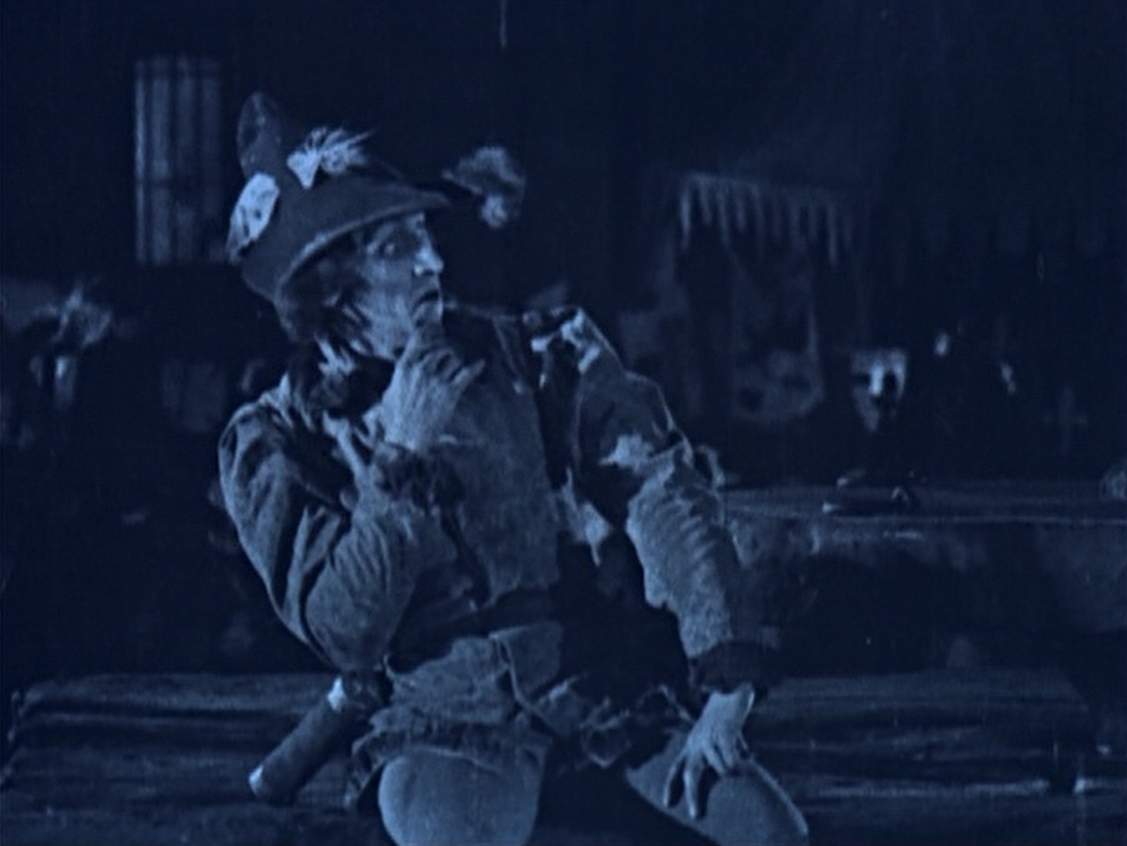
Hurst plays the character competently, but he's not allowed to explore the role in a unique or meaningful way. He's not in the movie enough to be a consistent threat. The audience starts to forget about him because the film is so concerned with Phoebus and Esmeralda's love story. Jehan, because of this, is not a very interesting or useful character.

I'll give him this though. He sure pioneered the cliche "holding cape over face to look spooky" gag.

Norman Kerry as Phoebus
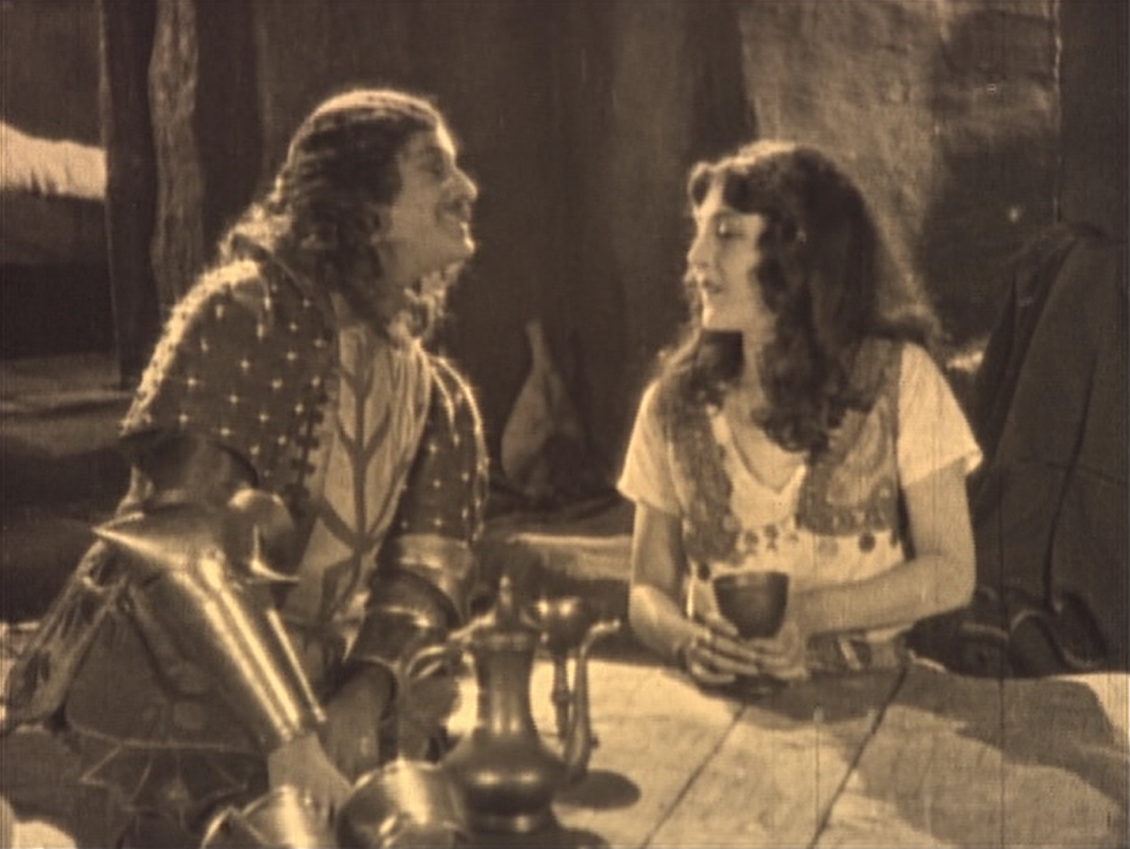
Phoebus is the exact opposite of how he was in the novel. Again, a heroic Phoebus, along with a lovesick Esmeralda and secular Frollo, is a carry-on from decades of adaptations doing the same sort of thing. He's not a particularly compelling take on this trope if I am being honest..

That doesn't mean the character is bad necessarily, but a leading man needs to do more than smile and stroke his mustache. In 1923, this type of characterization was typical, perhaps even encouraged. In retrospect, it's dated considerably. Norman Kerry really hams it up here. He's the apotheosis of every silent film hero ever.

Ernest Torrence as Clopin
Clopin, the "king of the underworld," is more developed than in the novel. He has a strong disdain for authority and dreams of a rebellion. He has a greater connection to Esmeralda, having bought her from Gypsies. He's a father figure to her, and tries his best to look out for her.

Gringoire, played in this film by actor Raymond Hatton is purely a comedic relief character. Unlike Edward Fitzball's Gringoire, he's actually funny. Also, as in that play, he is a sidekick of sorts to Captain Phoebus.

The actor just has a great look for the character, and truly takes advantage of pantomime to convey the role, as much as he can, physically. I really wish that he was in it more.

Next: Costumes and Makeup
Raymond Hatton as Pierre Gringoire

Saturday, September 12, 2015

The Plot: The Hunchback of Notre Dame (1923)

Exterior of Notre Dame
Ten years before Columbus discovered America, the people of Paris are celebrating the festival of fools. Looking down from the "rocky fastness of the cathedral" is Quasimodo, the "hunchback of Notre Dame." Quasimodo flicks his tongue at the city below, because he is "shut off from his fellow man by his deformities."

The king of France, Louis Xi, is worried by the rabble of the people, viewing it as an insult to both God and king. But Paris has another monarch, Clopin, the "king of the beggars" who pines for the day his people will rise above the aristocrats. A girl tries to aquaint herself with Clopin, but the beggar king tosses her asside. Dom Claude, the "saintly archdeacon of Notre Dame," comes to her aid and calms Clopin down.
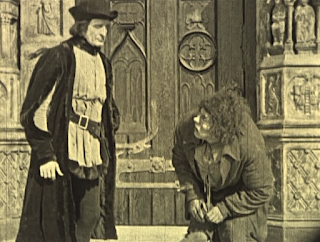
Quaismodo and Jehan

Jehan, Dom Claude's irreverent brother, converses with Clopin about how one day they will bow before no other men. The people look to Notre Dame in terror. Quasimodo climbs, like a lizard, from the top of the cathedral to the very bottom. When on the ground, Quasimodo snarls at the people, but flinches at the sight of Jehan, who explains that Quasimodo is his slave. Jehan orders Quasimodo to follow him and he complies.

Then, Esmeralda, the"child of mystery" shows up. Gudule, a mad recluse curses at her. Marie, the queen of the gypsies, comforts her. Out of earshot, two older women explain how Gudule used to be happy before her daughter was stolen from her. Gudule prays day and night for her child to return, and irrationally hates Esmeralda.
Quasimodo watches Esmeralda dance

The festival of fools continues into the night. Quasimodo, for his exceptional ugliness, has been crowned the "king of fools." Gringoire, a "poet of the streets" takes delight and grimaces at Quasimodo's appearance. Clopin calls upon Esmeralda, whom he has adopted, to dance. Quasimodo bursts through the crowd of spectators to see her. Esmeralda, upon seeing the misshapen hunchback, is disgusted. She turns her nose to him and continues her dancing. Quasimodo is crushed by this gesture.

Fleur de Lys and Phoebus admire Esmeralda
To escape the "reveling mob" at the festival, Louis Xi goes to the Bastille for peace and quiet. While there, here promotes the dashing Phoebus de Chateaupers to the title of Captain of the Guard.  Phoebus tries to kiss the king's hand to show his gratitude,  but he retreats, brushing himself off.

Phoebus returns to the home of his fiance, Fleur de Lys. The two of them admire esmeralda, who is dancing in the street. Fleur seems more humored by the "pretty goat," that Esmeralda uses to preform tricks, but Phoebus is more interested in Esmeralda herself. Phoenus is called by a fellow soldier to come to the barracks.

Quasimodo rings the bells of Notre Dame. Once finished, he leaves the bell tower, satisfied. As Phoebus rides to his destination, he pays a visit to Esmeralda. To her, Phoebus is the "prince charming of her dreams." The two exchange glances before Phoebus has to ride off.

Jehan keeping a low profile
Jehan rushes through the group of spectators circled around Esmeralda. Every time that Jehan saw Esmeralda "he longed to posses her." He looks over the head of the spectators and sees Quasimodo, just outside of the enterence to Notre Dame. Jehan plans on kidnapping Esmeralda for himself, and intends on using his hunchbacked slave to do it for him. Because Jehan knows Esmeralda's path home, he and Quasimodo follow her into the night. On Jehan's orders, Quasimodo tries to grab hold of Esmeralda, but he is stopped by the local watchmen. Phoebus, part of the group, is viewed as a hero by Esmeralda. Quasimodo is tied up and taken away, but Jehan leaves unscathed.

Phoebus and Esmeralda
Phoebus rides off with Esmeralda and takes her to the Pomme d'Eve. To Phoebus, Esmeralda is just "another girl." To Esmeralda, Phoebus is a "golden dream come true." He tries to seduce her, but she refuses his advances. Phoebus, out of repect, chooses not to anyway and leaves.

Gringoire, by accident, ends up in the court of miracles, a city of thieves and vagrants. The court is ruled by Clopin, who sentences Gringoire to be hanged for trespassing. Esmeralda prevents this from happening. Clopin allows Gringore to live, but only reluctantly.
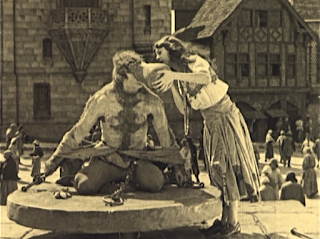
"Pity that overlooks all"
The next day, Quasimodo is on trial. He is sentenced to be whipped and he pleads to the judge. For that, twenty lashes are added to his punishment. Quasimodo is tied down the the pillory and is given "his first taste of the king's justice." As Quasimodo is being flogged, the crowd watching are jeering and some kiss each other. After his whipping is done, Quasimodo is left on the pillory for another hour. He tells the people that "I thirst," and is met with laughter.

Esmeralda passes by and is screamed at by Gudule, who says that she should be whipped instead of Quasimodo. Esmeralda sees Quasimodo in anguish and decides to take pity on him. She gives him a pitcher of water, and while he hesitates at first he eventually drinks from it graciously. Dom Claude comes to Quasimodo's aid, and unties his bonds.

To celebrate Phoebus becoming a captain of the guard, a ball is being held. Phoebus invites Esmeralda to come with him, but she is reluctant to. She feels her clothes are not good enough. Fortunately for her, Phoebus has prepared an outfit for her.

In Notre Dame, Quasimodo bumps into Jehan. Jehan seems a bit frightened of his hunchbacked slave and walks away from him. For betraying him in his time of need, Quasimodo has begun to bitterly hate Jehan. Dom Claude calms Quasimodo's rage with a touch of his hand. The hunchback follows him instead of Jehan.

Esmeralda intervenes 
At the ball, the aristocrats are bothered by Esmeralda's presence. Fleur de Lys is particularly offended. Suddenly, Clopin and the vagabonds storm in, demanding Esmeralda. Clopin tells Phoebus to give Esmeralda back or else he'll slit his throat. Esmeralda intervenes between the two of them.

 Clopin backs down, but only because his adopted daughter told him to. The king of the beggars, before leaving with his people, tell the aristocrats that they won't trample over his kind forever.

Gringoire is now a friend of Phoebus. The two try to have dinner, but because Phoebus is so concerned about Esmeralda he unintentionally ruins every attempt Gringoire makes to eat. Phoebus receives a later from Esmeralda telling him to meet her in Notre Dame. In the court of miracles, the idea dawns on Clopin: he is losing Esmeralda.  Marie doesn't want Esmeralda to leave, but she must. She wants to give herself to Phoebus and the virgin Mary.
Quasimodo watches the two lovers walk away
Jehan enters, covering his face with his cloak. He offers "half the treasure in Notre Dame" for the opportunity to marry Esmeralda. Clopin is tempted by the thought of his downtrodden people being like kings, but refuses. The time for uprising is not now.

Inside the cathedral, Esmeralda is overwhelmed by the beauty of the church. She find Phoebus near a pillar and goes to him. The two embrace when they notice Quasimodo. The hunchback had been lighting candles nearby, and he hides his face when they see him. Esmeralda smiles and he smiles back, but Phoebus insults him. Up above, Jehan witnesses what is happening and decides to follow them. The two lovers walk away to a garden, leaving Quasimodo alone.

In the garden, Phoebus promises his love to Esmeralda. Before they can finish, Jehan comes out from the shadows and stabs Phoebus. He runs away. Esmeralda tries to help her injured lover, but she is arrested. People believe that she is responsible.
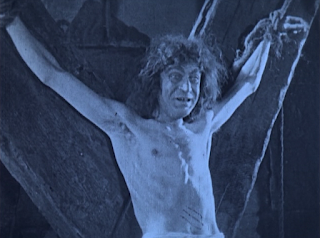
A victim of the "question"
While on trial, Esmeralda denies the accusations against her. She points to Jehan, a member of the jury, as the true culprit. Jehan tells the judge that Esmeralda is "bewitched," which leads her to being sent to the "question," the middle age's method of justice. Esmeralda is brutally tortured. She confesses simply for the sake of relieving her pain. For this, Esmeralda is sentenced
to be hanged.

Phoebus, all the while, is gradually recovering. Jehan is allowed to visit him, with the assistance of Fleur de Lys. Jehan informs Phoebus that that "the wench" who stabbed him is going to be executed. Instead of being pleased, Phoebus is mortified by the thought.

Enraged by Esmeralda's condemnation, Clopin struts into Notre Dame and demands that Dom Claude return her. The archdeacon is busy with Quasimodo, praying. Dom Claude tells Clopin that she has already been found guilty. He can do nothing to help, only able to offer religious guidance.  Clopin laughs at the idea. Quasimodo pounces upon Clopin, meaning to attack him, but Dom Claude prevents it. Dom Claude and Quasimodo return to prayer and Clopin leaves the church.

Jehan and Esmeralda
Imprisoned, Esmeralda is visited by a priest. However, the priest reveals himself to be none other than Jehan. The archdeacon's brother tells her to "come with (him)" because, he lies, Phoebus wanted her to. Esmeralda sees through this, calling him an "assassin." Rejected, Jehan leaves her to die.

Esmeralda is brought before a mob of jeerers in a wooden cart. Gudule, knowing that the girl she so deeply hates is going to die, leaves her cell to murder Esmeralda on her own. The guards throw the hag aside, and bring Esmeralda to the gibbit. In the struggle, Gudule ripped off Esmeralda's necklace. This necklace belonged to her long lost daughter. Putting two and two together, she realizes that Esmeralda is actually her daughter. This shock is so great that Gudule dies on the spot.

Quasimodo watches Esmeralda sleep
Quasimodo watches the events below with workman repairing the cathedral. He slides down on a rope, knocks over the officials, and snatches up Esmeralda. The gaurds rush to the cathedral to stop him, but Dom Claude prevents them from doing so. He asks if they would dare "violate the sacred law of sanctuary."

In the sanctuary, Esmeralda is terrified of her rescuer. She soon comes around to the poor hunchback, petting him like an animal, making Quasimodo content.

To show his joy, Quasimodo rings the church bells, first with his feet and then with the whole force of his body.

In the court of miracles, Jehan tells Clopin that the king, fearing an uprising, has ordered Esmeralda to be hanged. To prevent this, Clopin raises an army to storm Notre Dame, plunder it, and bring
her back.

Quasimodo attacks Jehan
Quasimodo discovers the army of vagabonds ramming the church with spheres. Esmeralda watches in horror as Quasimodo hurls stones on the mob. The king, hiding in the Bastile, orders his men to stop the riot. The vagabonds are attacked by an army of soldiers, but their efforts to fight back are in vain, Clopin tells his people to fight on before he succumbs to his wounds and dies.

The death of Quasimodo
The hunchback finds his master attacking his only love. Jehan tries to tell Quasimodo to leave, only to have his slave retaliat. He violently strangles Jehan. In vain, Jehan stabs Quasimodo's hump with a dagger. The hunchback in spite of his pain, pushes his master to his death. Esmeralda turns from the scene in terror.

Phoebus arrives on the scene. He and Esmeralda embrace.
Quasimodo is severely wounded from the stabbing. He lips into the belfry, and rings the bells one final time before dying. Dom Claude and Gringoire discover the body, and the archdeacon prays on his behalf.

Next: Characters

Saturday, August 8, 2015

Introduction: The Hunchback of Notre Dame (1923)

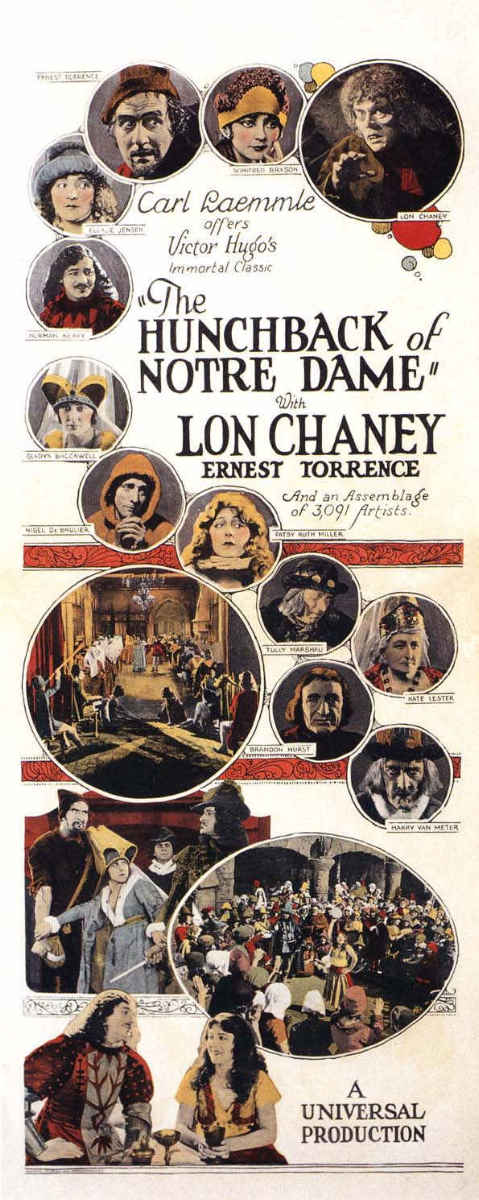
Film poster
The Hunchback of Notre Dame (1923) is the oldest surviving movie
adaptation. All previous film versions are either incomplete or completely lost. It was the film that launched Lon Chaney into the public eye and it helped to legitimize Universal as more than just a 'B' grade movie Studio.

Hunchback led to Universal pursuing similar vehicles, like The Phantom of the Opera in 1925. Phantom's success resulted in more macabre stories like it. Without Hunchback, the Universal monster movies of the 1930s would have never happened, and the Universal of today might not have happened. Its influence is enormous.

It was remade by RKO studios in 1939, with Charles Laughton playing Quasimodo.

The film has been in the public domain since around 1951, and is readily available today. You could legally watch it online. There are dozens of DVD releases, most in very low quality, and a recent Blu-ray transfer. The version that I will be using as a reference is the Image Entertainment Ultimate Edition from 2007. The image is remastered and a new symphonic score has been added. On top of that, an audio essay by Lon Chaney expert Micheal F Blake as well as a replica of a souvenir program that was printed during the film's release is included.

Next: The Plot

Conclusion: Parīzes Dievmātes Katedrāle

The actors applaud the composer
I was surprised by how much I enjoyed Parīzes Dievmātes Katedrāle. 

I only wish it was commercially available in the United States, even if it was just the soundtrack. It's almost tragic how the Dingo Pictures and Jetlag Productions' adaptations are easier to find than this, but there's always hope.

With great music, creative lighting, and a cast of immensely talented actors, imanages to be both one of the most faithful and one of the most inspired adaptations of the Victor Hugo story.

Parīzes Dievmātes Katedrāle is an overlooked and underrated gem of an opera.

Friday, August 7, 2015

Music: Parīzes Dievmātes Katedrāle

Coppenole addresses the crowd
If you recall from my review of La Esmeralda (1836), I'm not an expert on music. I certainly am not an expert on opera. I like what I like. I probably am not ideal to ask about the quality of a composition or the flow of the lyrics. Especially because I do not speak a word of Latvian.

It would seem that this would be a disaster for me, right? Well no. I loved the music of Parīzes Dievmātes Katedrāle. That's not a word I tend to throw around loosely. The music moved me, in an emotional sense. The music is fully orchestrated, unlike a certain other stage version, and the voices of the singers are instruments on their own. The drama is made through the harmony of the both of them. It's also light when it needs to be, like during the election of the pope of fools and Phoebus's argument with what he thinks is a ghost.

My personal favorite pieces were the "Garden of Flowers" scene with Quasimodo and Esmeralda and the scene when Gudule grieves over her lost daughter. With my only reference being the often spotty subtitles, I think the lyrics are very well done. I couldn't even imagine someone trying to make an English translation. It seems like something that can only work in its native language.

thoroughly enjoyed the music of Parīzes Dievmātes Katedrāle.

Next: Conclusion

Thursday, August 6, 2015

Sets, Lighting, and Costumes: Parīzes Dievmātes Katedrāle

There is not much in the way of sets in  Parīzes Dievmātes Katedrāle. The people involved do well with minimal sets. It's a testament to the quality of the blocking and staging that I hardly notice repeated locations.

The stage for the mystery play also serves as a whipping post for Quasimodo, an old alley, and a bell tower. Instead of large sets which, while nice, are also costly, this version is more humble. A rose window and some lights are all that is needed to convey the idea of a cathedral interior. I dare to say that Parīzes Dievmātes Katedrāle looks better than the 1977 version. While that's not saying much, it goes to show how limitations can help and when they can hinder. In the '77 film, the minimal sets were distracting. Here, they are engrossing.


The lighting around Gudule makes her stand out as abnormal
Lighting is a very important in theater, and it is used to great effect here. An example of how lighting can set the mood is when it shows the difference between characters. A good example is during Esmeralda's introduction. While she dances and delights the public, the lighting is warm and inviting, but as soon as Gudule enters and begins spewing hatred, the lighting changes. The light around Gudule is an unnatural and sickly turquoise, making her stand out from the warmly light Esmeralda.

Esmeralda dragged before the Hellish mob
The lighting sets the mood in a visually dynamic way. In a scene with high drama, like the moments awaiting Esmeralda's execution, the light on the mob is blood red, while the innocent Esmeralda is the only character under traditional lighting.

It also is applied very well with Quasimodo. The areas around him are often obscured in shadow, making the misshapen hunchback catch your eye. The light around him, unlike the harsh blackness, is cool, and melancholyScenes with Frollo are also very dark, but the little light surrounding him is white and threatening. 

They didn't have to do these things. They could have easily stuck to flat stage lighting, but they didn't. They use it to help tell the story, which is never a bad thing.

The costumes, unlike the sets, are highly detailed. Every character is visually distinct, which is important for any form of stage entertainment. Every person in the audience should be able to tell what is happening no matter where they are seated. The makeup is also well done. Frollo and Gudule have age makeup on, and look like they have gotten older since the opening scenes. Quasimodo's makeup, while not as grotesque as the novel, is made up by actor's performance. The ways he contorts his body make him look the part.

On the whole, the production values are really impressive.

Next: Music

Tuesday, August 4, 2015

Characters: Parīzes Dievmātes Katedrāle

Esmeralda with Djali
While often faithful to the novel, Parīzes Dievmātes Katedrāle has its own unique interpretation of the characters.

Esmeralda strikes a balance between innocent and mature. As a result, she is much more likable than she is in the novel, as she is more independent and less petty. She stands up for Quasimodo, despite his worry that she is going to harm him, and fights back against Frollo's advances, just to name a few examples. But that sense of innocence, while less pure naivete, is still there. Her first song, describing how she wishes that "dreams could come true," contrasts with her final words before her untimely death, gasping of "the pain" and "peace" of it all.


Quasimodo
Quasimodo, played by Latvian rock star Igo, is the highlight of the show. While the majority of the cast do their jobs fairly well, it's the little bits of acting such as the way he lumbers about and the range of his voice that make him memorable. This version places less emphasis on Quasimodo's facial deformity as it does his physical abnormality. Quasimodo is often referred to, by himself and others, as a "cripple," and lame person. Quasimodo's plight is used less for audience sympathy as it to draw a comparison.When Frollo, near the beginning, likens adopting the infant Quasimodo to when"Jesus went to the lame and the sick," this notion seems clearer.
Claude Frollo

Claude Frollo is one of the most developed versions of the character in any adaptation I've seen. Unlike, say, the 1982 Hallmark TV movie or the recent Disney stage musical, Frollo isn't portrayed as an ideal saint before he saw Esmeralda. While his backstory is not really examined, it doesn't need to be. His character is developed through the music. Frollo is a threatening and often frightening villain because of his failed humanity, and that concept is shown beautifully in this opera. Sergejs Martinovs does a fine job playing madness without resorting to camp or caricature.
Gudule and Esmeralda

Gudule's importance is increased in this opera, unlike the novel where she was part of a minor subplot. She doesn't have any extras scenes really, but they are interspersed throughout instead of short chapters. She's more sympathetic here because of the way the character is framed. In the book, Gudule is a crazy old hag first before her motivation is explored. This is the case for a lot of characters in the novel, likely to enforce the "deception of appearance" theme. While that may work for a novel, the opera chooses a more conventional method of storytelling, and it succeeds as a result. In the case of Gudule, I can certainly say that this in an improvement.


Pierre Gringoire
Pierre Gringoire is not particularly different from his literary counterpart. He's given a bit of pathos, which is refreshing after Fitzball's and Jetlag Productions' flat comic relief. Being that Jehan Frollo is absent from this adaptation, the author decides to combine include elements of that character into Gringoire, such as the scene where he asks Frollo for money. While I usually don't like when adaptations of books combine characters, it works very well here. One strange addition to this adaptation is a scene where Gringoire is nearly raped by a group of women in the court of miracles. I'm not sure what the point of this scene really is. I suppose it is effective in showing the court as a dangerous place, but the scene is played more for laughs than anything else. (Then again, that itself is a bit problematic.) 


Fleur de Lys and Phoebus
Phoebus is also basically unchanged from the novel. Both his arrogance and ignorance are used for comic and dramatic affect throughout. Fleur de Lys also is similar, but works nonetheless. The two of them have a certain chemistry together. There are shifts of power that I really like. Early on, Fleur de Lys admires Phoebus as an idea hero and he plays the part on the surface. However, after she discovers his misadventure with Esmeralda, Fleur de Lys has power over Phoebus and says that they will  be together forever once married. It's an expansion of a concept hinted at near the end of the book, and it's both humorous and dramatically satisfying.


Clopin and a beggar
Clopin is also not very different from how he is in the book. He's filthy and cruel, but not humorless as in the French musical or Hallmark TV movie. There's also a lot of vulgarity with this Clopin, and it works very well. I really like this interpretation, and the actor seems to be having a lot of fun playing the character. 

The extras all of a bit of personality, which usually is not the case in theater productions. It's fun to spot the wiry man with a crutch hobble about with a paranoid gaze or the noble women who talk with their hands. Details like this make the world come alive.

Next: Sets, Lighting and Costumes